Part 9: The FinOps Lifecycle
Main Idea
- FinOps works through a continuous lifecycle of inform, optimize, and operate.
- The lifecycle is iterative, not linear, and organizations improve by cycling through it repeatedly over time.
- The goal is to combine visibility, decision-making, and operational action so cloud spending aligns with business value.
Why This Matters
- Principles alone are not enough; organizations need a repeatable way to apply them.
- The lifecycle turns FinOps principles into practical actions.
- Teams improve cloud efficiency most effectively when they can see spend clearly, decide what to improve, and then operationalize those improvements.
The Six Principles of FinOps in Action
- Teams need to collaborate.
- Decisions are driven by the business value of cloud.
- Everyone takes ownership of their cloud usage.
- FinOps reports should be accessible and timely.
- A centralized team drives FinOps.
- Teams should take advantage of the variable cost model of the cloud.
Principle 1: Teams Need to Collaborate
- FinOps requires finance, engineering, product, and business teams to work together.
- Collaboration reduces silos and makes cost a shared concern instead of a separate finance problem.
- A blameless culture matters because teams learn faster when cost overruns are treated as improvement opportunities rather than occasions for blame.
Real life example:
- No blame
- Offers solution
- Collaborative
- Solved in less than 4 hours.
Hello Friend,

I wanted to bring to your attention to what appears to be duplicative Entra ID logging into the xxxyyyzzz log analytics workspace, which has resulted in additional substantial costs to the firm—approximately $10,000 per month—since February. It’s important to note that this data is already being ingested into our MS Sentinel log analytics workspace at a more favorable rate than the current Pay As You Go pricing on the xxxyyyzzz workspace and it’s already there and not duplicated.

I've looped in <collaborator> on this thread, as I believe his input will be valuable. I’m confident that by collaborating, we can identify a solution to migrate those runbooks to pull from our existing MS Sentinel data, eliminating the need to duplicate these logs in a separate log analytics workspace.

One solution that I’d like to propose is that we give the xxxyyyzzz managed identity read permissions on the sentinel LA workspace and then point the runbooks to that workspace.
Of course, we need to ensure that we’re careful not to give that managed identity overly broad permissions and remain mindful about the potential crossover of production data into development environments.

Looking forward for everyone’s thoughts on this as we work together to optimize our cloud spend.
Principle 2: Decisions Are Driven by Business Value of the Cloud
- Cloud should be treated as a value creator, not only as a cost center.
- The right question is not just how much cloud costs, but what business value the spend creates.
- Teams should focus on value-linked measures such as cost per business metric, not just total monthly spend.
- Maximize the value of cloud investments, not just minimize the cost.
Principle 3: Everyone Takes Ownership
- Cloud cost follows cloud usage.
- The teams using cloud resources are accountable for understanding and improving that usage.
- FinOps succeeds when accountability is pushed out to the teams closest to the workload.
Principle 4: Reports Must Be Accessible and Timely
- Cloud decisions happen too quickly for monthly or quarterly cost visibility to be enough.
- Teams need near-real-time cost and usage information in order to react effectively.
- Decisions should be based on clean, fully loaded, properly allocated data.
- Data needs to be in the hands of those who can act on it, not just in the hands of the FinOps team.
Principle 5: A Centralized Team Drives FinOps
- A central FinOps function provides education, standardization, advocacy, and improved tooling.
- The central team helps the organization do FinOps better, while decentralized teams remain responsible for the usage decisions closest to the work.
- The strongest model is to decentralize responsibility to use less and centralize responsibility to pay less.
Principle 6: Use the Variable Cost Model of Cloud
- Cloud spending should be managed using actual usage patterns, not static infrastructure assumptions.
- Rightsizing, discount strategies, and scaling decisions should be based on real consumption.
- Mature organizations take advantage of cloud-native models that scale more efficiently with demand.
The FinOps Lifecycle
- The lifecycle has three phases:
- Inform - gives you visibility and accountability of your cloud spend.
- Optimize - helps you identify the best opportunities to improve and set goals for action.
- Operate - turns those goals into repeatable processes, workflows, and automation.
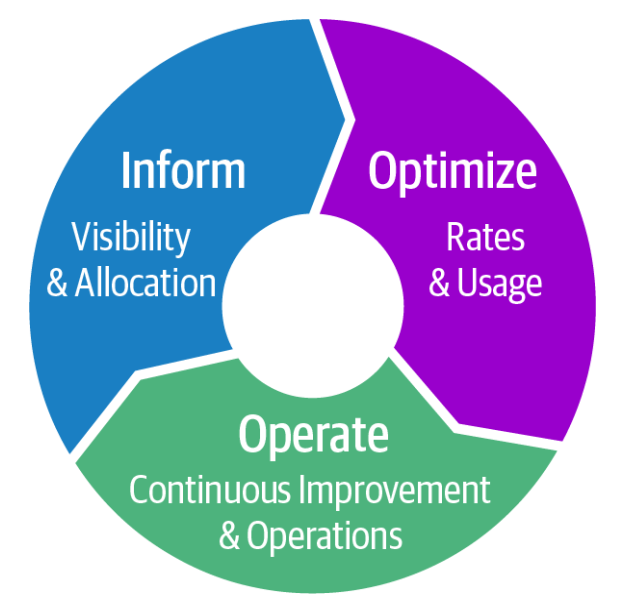 These phases repeat continuously.
Each pass through the lifecycle should focus on the most important issues visible in the latest data.
Be mindful of the Prius Effect, where timely visibility into usage or spend changes behavior by creating a real-time feedback loop.
These phases repeat continuously.
Each pass through the lifecycle should focus on the most important issues visible in the latest data.
Be mindful of the Prius Effect, where timely visibility into usage or spend changes behavior by creating a real-time feedback loop.
How the Lifecycle Works
- Inform creates visibility and accountability.
- Optimize identifies improvement opportunities and sets goals.
- Operate turns those goals into repeatable processes, workflows, and automation.
- Then the cycle repeats with better visibility and better decisions.
Inform Phase
- The inform phase is where teams understand what they are spending, where the money is going, and who is responsible.
- This phase builds the visibility needed for shared accountability.
Key Activities in Inform
- Map spending data to the business - tags and allocation are critical here.
- Create showback or chargeback reporting - pushes spend accountability
- Define budgets and forecasts - helps teams plan and set expectations.
- Define account strategy - use Azure Landing Zones and management groups to create a structure that supports allocation and reporting.
- Set tag strategy and compliance - ensures consistency for reporting and accountability.
- Identify untagged and untaggable resources - critical to keep accurate.
- Allocate shared costs fairly - appropriate ratios
- Calculate custom rates and amortized costs - ensures teams see the true cost of their usage.
- Analyze trends and variance - time periods and resource usage
- Create scorecards - compare teams, projects, or workloads on cost and efficiency measures.
- Benchmark against industry peers - provides context for performance.
- Identify anomalies - detect unexpected patterns or outliers.
Why Inform Comes First
- Teams should understand cost drivers before they start changing infrastructure.
- Accurate allocation and visibility are prerequisites for smart optimization.
- Without this phase, teams risk acting on incomplete or misleading cost signals.
Optimize Phase
- The optimize phase focuses on identifying the best improvements and deciding which ones matter most right now.
- It converts visibility into prioritized opportunity.
Key Activities in Optimize
- Analyze KPIs and set goals - decide what to improve and by how much.
- Find underutilized services and resources - identify where you can save by rightsizing or turning off.
- Measure potential savings and efficiency gains - estimate the impact of potential actions.
- Evaluate centralized commitment-based discount strategies - identify where reserved instances, savings plans, or other discounts can be applied for better coverage.
- Review existing commitment usage and identify better coverage opportunities - same as above but focused on improving existing commitments.
Focus of Optimize
- Cost avoidance should usually come first.
- Teams should identify the most meaningful and measurable improvements before operationalizing them.
- This phase is about choosing what to act on, not just spotting everything that could be improved.
Operate Phase
- The operate phase turns optimization goals into regular practice.
- This is where organizations build the workflows, automation, and habits needed to sustain improvement.
Key Activities in Operate
- Deliver spend data to stakeholders regularly.
- Make cultural changes that support accountability and learning.
- Rightsize resources or turn them off when appropriate.
- Define governance and controls for cloud usage.
- Continuously improve efficiency and innovation.
- Automate optimization where possible.
- Push recommendations into normal workflows.
- Integrate chargeback into internal systems.
- Establish policy-driven tag cleanup and storage lifecycle policies.
Operate Is About Repeatability
- Mature FinOps teams do not rely only on manual review.
- They operationalize decisions through process and automation.
- This phase helps ensure FinOps becomes part of normal business and engineering behavior.
Important Considerations Across the Lifecycle
- Unit economics.
- Culture.
- Speed of delivery.
- Value to the business.
Unit Economics
- Tying cloud spend to business outcomes is essential.
- Growing spend is not automatically bad if the business value per unit improves.
- Unit economics helps leadership discuss cloud cost in a way that reflects outcomes, not just totals.
Culture
- Weak communication and siloed teams often explain poor utilization or weak discount coverage.
- FinOps maturity depends on training, shared language, and proactive behavior from teams.
- Cultural adoption should be evaluated continuously, not assumed.
Speed of Delivery
- Cost, quality, and speed are linked.
- Organizations may need to adjust tradeoffs deliberately depending on project goals and business priorities.
Value to the Business
- Cloud spending should be evaluated in the context of what the project or service is worth to the business.
- This helps avoid over-optimizing the wrong thing or under-investing in valuable workloads.
Where to Start
- Start with inform.
- Get visibility into spending before jumping into optimize or operate.
- Clean up allocation and ownership first so the right teams can act on the right signals.
Do Not Boil the Ocean
- FinOps maturity takes time.
- Large, rushed moves can create expensive mistakes.
- Incremental improvement is safer and more effective than trying to solve everything at once.
You Do Not Need All the Answers Up Front
- Sometimes simply showing teams their costs creates strong autonomous improvements.
- Visibility alone can drive better behavior without the FinOps team prescribing every action.
- This is why usage optimization is pushed outward to the teams closest to the work.
Strategic Lessons
- The lifecycle is continuous and never fully complete.
- Inform creates the clarity needed for optimize.
- Optimize sets the priorities that operate makes real.
- Progress comes from repeated iterations, not one-time transformation.
- Real-time, granular visibility is the most important starting point.
Key Takeaways
- FinOps runs through a continuous loop of inform, optimize, and operate.
- Each phase depends on the quality of the previous one.
- Start with visibility and allocation before pushing major changes.
- Keep improvements incremental and repeatable.
- Let teams closest to usage own their usage decisions.
- Use clean, timely data to support business-value-driven decisions.
Conclusion
- The FinOps lifecycle comprises three main phases that you continuously cycle through.
- Improve with each iteration of the lifecycle. Do not try to do everything at once.
- Involve your cross-functional teams early and often so they can learn with you.
- Constantly look for opportunities to refine your processes, but move quickly from phase to phase.
- The most critical thing you can do is provide your teams with granular, real-time visibility into their spending.
- Before you can do anything else, you need to fully load and allocate your costs, factoring in your custom rates, filling allocation gaps, distributing shared costs, remapping spend to your organizational structure, and accounting for amortizations.
Glossary
| Term | Definition |
|---|---|
| Blameless culture | A working model where cost issues are treated as opportunities to learn and improve rather than moments to assign blame. |
| Chargeback | A model that assigns cloud costs directly back to the responsible team or business unit. |
| Custom rates | Organization-specific rates that reflect negotiated discounts or pricing arrangements rather than public list prices. |
| FinOps lifecycle | The continuous cycle of inform, optimize, and operate used to improve cloud financial management over time. |
| Inform phase | The lifecycle phase focused on visibility, allocation, benchmarking, forecasting, and accountability. |
| Metric-driven cost optimization | An approach that uses monitored metrics and thresholds to trigger optimization activity instead of relying only on manual review cycles. |
| Operate phase | The lifecycle phase focused on building processes, workflows, governance, and automation to carry out FinOps decisions. |
| Optimize phase | The lifecycle phase focused on identifying the most important efficiency and savings opportunities and setting goals for action. |
| Prius Effect | The behavioral effect where timely visibility into usage or spend changes behavior by creating a real-time feedback loop. |
| Scorecard | A comparative view used to benchmark teams or workloads on cost, efficiency, speed, or quality measures. |
| Shared costs | Costs for services or resources used by multiple teams that must be allocated fairly to reflect true ownership. |
| Showback | A reporting model that gives teams visibility into their costs without formally charging them. |
| Tag strategy | The structured plan for using metadata to support allocation, ownership, and reporting. |
| Untaggable resources | Resources or charges that cannot be tagged directly and therefore need some other allocation method. |
| Untagged resources | Resources that should have metadata for allocation and ownership but do not currently have it. |
| Unit economics | Cost measures tied to business outcomes, used to judge whether cloud spend is creating value efficiently. |
| Variable cost model of the cloud | The cloud pricing model in which cost changes with usage, demand, and behavior instead of staying fixed. |